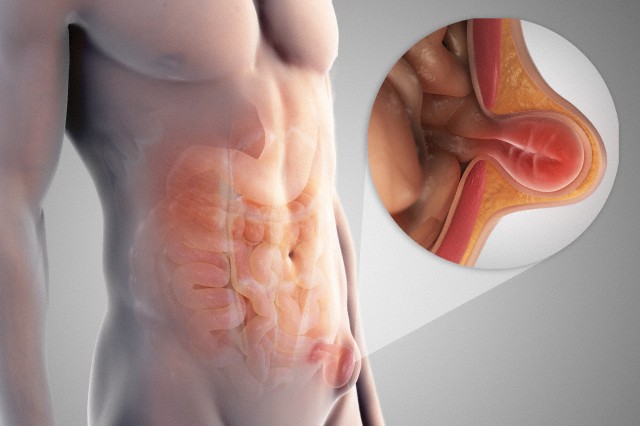
A hernia is a gap or space in the strong tissue that holds muscles in place. A hernia occurs when the inside layers of the abdominal muscle have weakened, resulting in a bulge or tear. In the same way that an inner tube pushes through a damaged tyre, the inner lining of the abdomen pushes through the weakened area of the abdominal wall to form a small balloon like sac. This will cause a loop of intestine or abdominal tissue to push into the sac. The hernia can cause discomfort, severe pain, or other potentially serious problems like strangulation that could require emergency surgery.
A hernia does not get better over time, nor will it go away by itself. There are no exercises or physical therapy regimen or yoga that can make a hernia go away.
Depending on their location, most hernia appear as a swelling , which may be painful. The swelling will often appear when you are straining or lifting something and disappear when you lie down and relax. In a small number of people they may present with bowel obstruction due to bowel getting trapped (strangulation) within the hernia, which is a medical emergency which can be serious.
Both men and women can get a hernia. You may be born with a hernia (congenital) or develop one over time. Hernias in adults may arise as a result of the strain which raises the pressure in the abdomen, causing a weakness or tear in the abdominal wall. This can be caused by:
Hernia is usually noticed after a strain – for example, after lifting a heavy object. Sometimes you may simply notice a small lump, usually in the groin area. Usually, at first, the lump can be pushed back, but may come out after straining again. Coughing, lifting heavy objects or prolonged standing is a common strain that brings them out. The swelling often disappears when you lie down.
Hernias are not usually painful, but many people feel an ache over a hernia, which worsens after doing any activity. In time, they might become bigger as the gap in their muscle or ligament tissue becomes larger. If the hernia doesn’t reduce, becomes red or painful, it has obstructed and is in danger of strangulation. It is an emergency and you should contact doctor immediately.
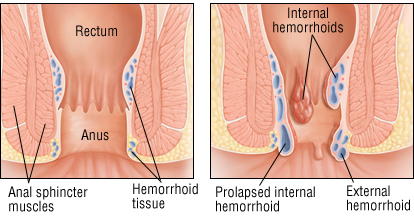
Haemorrhoids, also known as piles, are swellings that contain enlarged blood vessels that are found inside or around the bottom (the rectum and anus). Most haemorrhoids are mild and sometimes don’t even cause symptoms. When there are symptoms, these usually include:
The exact cause of haemorrhoids is unclear, although they are associated with increased pressure in the blood vessels in and around your anus. Most cases are thought to be caused by excessive straining on the toilet, due to prolonged constipation, often resulting from a lack of fibre in your diet. Things that can increase your risk of haemorrhoids include:
Most cases of piles (haemorrhoids) are mild, and the symptoms often disappear on their own after a few days. Some people may not even realise they have haemorrhoids, as they do not experience symptoms. However, when symptoms do occur they may include:
Haemorrhoids are not usually painful, unless their blood supply slows down or is interrupted.
An anal fissure is a tear or a small crack in the skin at lower end of the anus (back passage). The condition is also referred to as Fissure-in-ano. It is probably the result of pressure forced onto the wall of the anal canal either by passage of hard stool or straining with a loose stool.
What are the symptoms?